|
|
Berlekamp–Welch algorithm
The Berlekamp–Welch algorithm, also known as the Welch–Berlekamp algorithm, is named for Elwyn R. Berlekamp and Lloyd R. Welch. The algorithm efficiently corrects errors in BCH codes and Reed–Solomon codes (which are a subset of BCH codes). Unlike many other decoding algorithms, and in correspondence with the code-domain Berlekamp–Massey algorithm that uses syndrome decoding and the dual of the codes, the Berlekamp–Welch decoding algorithm provides a method for decoding Reed–Solomon codes using just the generator matrix and not syndromes.
Contents
History on decoding Reed–Solomon codes
- In 1960, Peterson developed an algorithm for decoding BCH codes. His algorithm solves the important second stage of the generalized BCH decoding procedure and is used to calculate the error locator polynomial coefficients that in turn provide the error locator polynomial. This is crucial to the decoding of BCH codes.
- In 1963, Gorenstein–Zierler saw that BCH codes and Reed–Solomon codes have a common generalization and that the decoding algorithm extends to more general situation.
- In 1968 / 69, Elwyn Berlekamp invented an algorithm for decoding BCH codes. James Massey recognized its application to linear feedback shift registers and simplified the algorithm. Massey termed the algorithm the LFSR Synthesis Algorithm (Berlekamp Iterative Algorithm) but it is now known as the Berlekamp–Massey algorithm.
- In 1975, Sugiyama et al. developed a decoder based on the extended Euclidean algorithm. Reed–Solomon_error_correction#Euclidean_decoder
- In 1986, The Welch–Berlekamp algorithm was developed to solve the decoding equation of Reed–Solomon codes, using a fast method to solve a certain polynomial equation. The Berlekamp–Welch algorithm has a running time complexity of Failed to parse (MathML with SVG or PNG fallback (recommended for modern browsers and accessibility tools): Invalid response ("Math extension cannot connect to Restbase.") from server "https://wikimedia.org/api/rest_v1/":): {\displaystyle \mathcal{O}(N^3)} . The following sections look at the Gemmel and Sudan’s exposition of the Berlekamp–Welch algorithm.
Error locator polynomial of Reed–Solomon codes
In the problem of decoding Reed–Solomon codes, the inputs are pair wise distinct evaluation points Failed to parse (MathML with SVG or PNG fallback (recommended for modern browsers and accessibility tools): Invalid response ("Math extension cannot connect to Restbase.") from server "https://wikimedia.org/api/rest_v1/":): {\displaystyle \alpha_1, \cdots, \alpha_n} where Failed to parse (MathML with SVG or PNG fallback (recommended for modern browsers and accessibility tools): Invalid response ("Math extension cannot connect to Restbase.") from server "https://wikimedia.org/api/rest_v1/":): {\displaystyle \alpha_i \in \mathbb{F}} with dimension and distance Failed to parse (MathML with SVG or PNG fallback (recommended for modern browsers and accessibility tools): Invalid response ("Math extension cannot connect to Restbase.") from server "https://wikimedia.org/api/rest_v1/":): {\displaystyle d = n - k + 1 } and a codeword Our goal is to describe an algorithm that can correct Failed to parse (MathML with SVG or PNG fallback (recommended for modern browsers and accessibility tools): Invalid response ("Math extension cannot connect to Restbase.") from server "https://wikimedia.org/api/rest_v1/":): {\displaystyle e < \tfrac{1}{2}(n-k+1)} many errors in polynomial time. To do so we have to find Failed to parse (MathML with SVG or PNG fallback (recommended for modern browsers and accessibility tools): Invalid response ("Math extension cannot connect to Restbase.") from server "https://wikimedia.org/api/rest_v1/":): {\displaystyle P \in \mathbb{F}[X]} such that Failed to parse (MathML with SVG or PNG fallback (recommended for modern browsers and accessibility tools): Invalid response ("Math extension cannot connect to Restbase.") from server "https://wikimedia.org/api/rest_v1/":): {\displaystyle \deg(P) < k - 1} and the number of indices for which Failed to parse (MathML with SVG or PNG fallback (recommended for modern browsers and accessibility tools): Invalid response ("Math extension cannot connect to Restbase.") from server "https://wikimedia.org/api/rest_v1/":): {\displaystyle P(\alpha_i) \ne y_i} is less than or equal to We can assume that there exists a polynomial Failed to parse (MathML with SVG or PNG fallback (recommended for modern browsers and accessibility tools): Invalid response ("Math extension cannot connect to Restbase.") from server "https://wikimedia.org/api/rest_v1/":): {\displaystyle P} such that


Note that the coefficients of Failed to parse (MathML with SVG or PNG fallback (recommended for modern browsers and accessibility tools): Invalid response ("Math extension cannot connect to Restbase.") from server "https://wikimedia.org/api/rest_v1/":): {\displaystyle P} are the encoded information. To solve this, we use an indicator for those indices where an error may have occurred. Thus we define an error locator polynomial, Failed to parse (MathML with SVG or PNG fallback (recommended for modern browsers and accessibility tools): Invalid response ("Math extension cannot connect to Restbase.") from server "https://wikimedia.org/api/rest_v1/":): {\displaystyle E \in \mathbb{F}[X],} by:
- Failed to parse (MathML with SVG or PNG fallback (recommended for modern browsers and accessibility tools): Invalid response ("Math extension cannot connect to Restbase.") from server "https://wikimedia.org/api/rest_v1/":): {\displaystyle E(X) = \prod_{1\leqslant i \leqslant n \atop y_i \ne P(\alpha_i)} (X - \alpha_i)}
Note that We can also claim that Failed to parse (MathML with SVG or PNG fallback (recommended for modern browsers and accessibility tools): Invalid response ("Math extension cannot connect to Restbase.") from server "https://wikimedia.org/api/rest_v1/":): {\displaystyle y_i E(\alpha_i) = P(\alpha_i) E(\alpha_i)} holds for all Failed to parse (MathML with SVG or PNG fallback (recommended for modern browsers and accessibility tools): Invalid response ("Math extension cannot connect to Restbase.") from server "https://wikimedia.org/api/rest_v1/":): {\displaystyle 1 \leqslant i \leqslant n} . This fact holds true because in the event of , both sides of the above equation vanish because Failed to parse (MathML with SVG or PNG fallback (recommended for modern browsers and accessibility tools): Invalid response ("Math extension cannot connect to Restbase.") from server "https://wikimedia.org/api/rest_v1/":): {\displaystyle E(\alpha_i) = 0} .


However, since and Failed to parse (MathML with SVG or PNG fallback (recommended for modern browsers and accessibility tools): Invalid response ("Math extension cannot connect to Restbase.") from server "https://wikimedia.org/api/rest_v1/":): {\displaystyle P} are both unknown, the main task of the decoding algorithm would be to find . To do this we use a seemingly useless yet very powerful method and define another polynomial Failed to parse (MathML with SVG or PNG fallback (recommended for modern browsers and accessibility tools): Invalid response ("Math extension cannot connect to Restbase.") from server "https://wikimedia.org/api/rest_v1/":): {\displaystyle Q = PE.} This is because the Failed to parse (MathML with SVG or PNG fallback (recommended for modern browsers and accessibility tools): Invalid response ("Math extension cannot connect to Restbase.") from server "https://wikimedia.org/api/rest_v1/":): {\displaystyle n} equations with we need to solve are quadratic in nature. Thus by defining a product of two variables that gives rise to a quadratic term as one unknown variable, we increase the number of unknowns but make the equations linear in nature. This method is called linearization and is a very powerful tool.


Thus Failed to parse (MathML with SVG or PNG fallback (recommended for modern browsers and accessibility tools): Invalid response ("Math extension cannot connect to Restbase.") from server "https://wikimedia.org/api/rest_v1/":): {\displaystyle Q \in \mathbb{F}[X]} having the properties:
- Failed to parse (MathML with SVG or PNG fallback (recommended for modern browsers and accessibility tools): Invalid response ("Math extension cannot connect to Restbase.") from server "https://wikimedia.org/api/rest_v1/":): {\displaystyle \deg(Q) \leqslant \tfrac{1}{2}(n - k) + k - 1}

This helps because if we now manage to find Failed to parse (MathML with SVG or PNG fallback (recommended for modern browsers and accessibility tools): Invalid response ("Math extension cannot connect to Restbase.") from server "https://wikimedia.org/api/rest_v1/":): {\displaystyle Q} and , we can easily find Failed to parse (MathML with SVG or PNG fallback (recommended for modern browsers and accessibility tools): Invalid response ("Math extension cannot connect to Restbase.") from server "https://wikimedia.org/api/rest_v1/":): {\displaystyle P} using . The main purpose of the Berlekamp Welch algorithm is to find out Failed to parse (MathML with SVG or PNG fallback (recommended for modern browsers and accessibility tools): Invalid response ("Math extension cannot connect to Restbase.") from server "https://wikimedia.org/api/rest_v1/":): {\displaystyle P} using degree bounded polynomials and Failed to parse (MathML with SVG or PNG fallback (recommended for modern browsers and accessibility tools): Invalid response ("Math extension cannot connect to Restbase.") from server "https://wikimedia.org/api/rest_v1/":): {\displaystyle E} and the properties of and .


Computing Failed to parse (MathML with SVG or PNG fallback (recommended for modern browsers and accessibility tools): Invalid response ("Math extension cannot connect to Restbase.") from server "https://wikimedia.org/api/rest_v1/":): {\displaystyle E} is as hard as finding the end solution Once Failed to parse (MathML with SVG or PNG fallback (recommended for modern browsers and accessibility tools): Invalid response ("Math extension cannot connect to Restbase.") from server "https://wikimedia.org/api/rest_v1/":): {\displaystyle E} is computed, using erasure decoding for Reed–Solomon codes, we can easily recover . However, in a few cases, even the polynomial Failed to parse (MathML with SVG or PNG fallback (recommended for modern browsers and accessibility tools): Invalid response ("Math extension cannot connect to Restbase.") from server "https://wikimedia.org/api/rest_v1/":): {\displaystyle Q} is as hard to find as . As an example, given Failed to parse (MathML with SVG or PNG fallback (recommended for modern browsers and accessibility tools): Invalid response ("Math extension cannot connect to Restbase.") from server "https://wikimedia.org/api/rest_v1/":): {\displaystyle Q} and (such that Failed to parse (MathML with SVG or PNG fallback (recommended for modern browsers and accessibility tools): Invalid response ("Math extension cannot connect to Restbase.") from server "https://wikimedia.org/api/rest_v1/":): {\displaystyle y_i \ne 0} for ), by checking positions where Failed to parse (MathML with SVG or PNG fallback (recommended for modern browsers and accessibility tools): Invalid response ("Math extension cannot connect to Restbase.") from server "https://wikimedia.org/api/rest_v1/":): {\displaystyle Q(i) = 0} , we can find the error locations. Thus the algorithm works on the principle that while each of the polynomials and Failed to parse (MathML with SVG or PNG fallback (recommended for modern browsers and accessibility tools): Invalid response ("Math extension cannot connect to Restbase.") from server "https://wikimedia.org/api/rest_v1/":): {\displaystyle Q} are hard to find individually; computing them together is much easier.


The Berlekamp–Welch decoder and algorithm
The Welch–Berlekamp decoder for Reed–Solomon codes consists of the Welch– Berlekamp algorithm augmented by some additional steps that prepare the received word for the algorithm and interpret the result of the algorithm.
The inputs given to the Berlekamp Welch decoder are the integers denoting Block Length Failed to parse (MathML with SVG or PNG fallback (recommended for modern browsers and accessibility tools): Invalid response ("Math extension cannot connect to Restbase.") from server "https://wikimedia.org/api/rest_v1/":): {\displaystyle n,} the number of errors such that Failed to parse (MathML with SVG or PNG fallback (recommended for modern browsers and accessibility tools): Invalid response ("Math extension cannot connect to Restbase.") from server "https://wikimedia.org/api/rest_v1/":): {\displaystyle e < \tfrac{1}{2}(n - k + 1),} and the received word Failed to parse (MathML with SVG or PNG fallback (recommended for modern browsers and accessibility tools): Invalid response ("Math extension cannot connect to Restbase.") from server "https://wikimedia.org/api/rest_v1/":): {\displaystyle (y_i ,\alpha_i)^n _{i=1}} satisfying the condition that there exists at most one Failed to parse (MathML with SVG or PNG fallback (recommended for modern browsers and accessibility tools): Invalid response ("Math extension cannot connect to Restbase.") from server "https://wikimedia.org/api/rest_v1/":): {\displaystyle P} with Failed to parse (MathML with SVG or PNG fallback (recommended for modern browsers and accessibility tools): Invalid response ("Math extension cannot connect to Restbase.") from server "https://wikimedia.org/api/rest_v1/":): {\displaystyle \deg(P) \leqslant k - 1} with Failed to parse (MathML with SVG or PNG fallback (recommended for modern browsers and accessibility tools): Invalid response ("Math extension cannot connect to Restbase.") from server "https://wikimedia.org/api/rest_v1/":): {\displaystyle \Delta(y, P(\alpha_i)_i) \leqslant e} .

The output of the decoder is either the polynomial , or in some cases, a failure. This decoder functions in two steps as follows:
- This step is called the interpolation step in which the decoder computes a non zero polynomial Failed to parse (MathML with SVG or PNG fallback (recommended for modern browsers and accessibility tools): Invalid response ("Math extension cannot connect to Restbase.") from server "https://wikimedia.org/api/rest_v1/":): {\displaystyle E} of degree Failed to parse (MathML with SVG or PNG fallback (recommended for modern browsers and accessibility tools): Invalid response ("Math extension cannot connect to Restbase.") from server "https://wikimedia.org/api/rest_v1/":): {\displaystyle e} (This implies that the coefficient of must be 1) and another polynomial Failed to parse (MathML with SVG or PNG fallback (recommended for modern browsers and accessibility tools): Invalid response ("Math extension cannot connect to Restbase.") from server "https://wikimedia.org/api/rest_v1/":): {\displaystyle Q} with These polynomials are created such that the condition Failed to parse (MathML with SVG or PNG fallback (recommended for modern browsers and accessibility tools): Invalid response ("Math extension cannot connect to Restbase.") from server "https://wikimedia.org/api/rest_v1/":): {\displaystyle y_i E(\alpha_i) = Q(\alpha_i)} holds for all In the case that polynomials satisfying the above condition cannot be computed, the output of the decoder would be a failure.
- If then a Failed to parse (MathML with SVG or PNG fallback (recommended for modern browsers and accessibility tools): Invalid response ("Math extension cannot connect to Restbase.") from server "https://wikimedia.org/api/rest_v1/":): {\displaystyle P} is defined which equals If Failed to parse (MathML with SVG or PNG fallback (recommended for modern browsers and accessibility tools): Invalid response ("Math extension cannot connect to Restbase.") from server "https://wikimedia.org/api/rest_v1/":): {\displaystyle \Delta(y, (P(\alpha_i)_i ) \leqslant e,} then the decoder outputs If the above condition is not satisfied, i.e. if Failed to parse (MathML with SVG or PNG fallback (recommended for modern browsers and accessibility tools): Invalid response ("Math extension cannot connect to Restbase.") from server "https://wikimedia.org/api/rest_v1/":): {\displaystyle E \nmid Q} then a failure is returned by the decoder.


According to the algorithm, in the cases where it does not output a failure, it outputs a that is the correct and desired polynomial. To prove that, the algorithm always outputs the desired polynomial, we need to prove a few claims we have made while describing the algorithm. Let us go ahead and do so now.
- Claim 1. There exist a pair of polynomials, Failed to parse (MathML with SVG or PNG fallback (recommended for modern browsers and accessibility tools): Invalid response ("Math extension cannot connect to Restbase.") from server "https://wikimedia.org/api/rest_v1/":): {\displaystyle (E, Q),} that satisfy Step 1 of the BW algorithm and

Let Failed to parse (MathML with SVG or PNG fallback (recommended for modern browsers and accessibility tools): Invalid response ("Math extension cannot connect to Restbase.") from server "https://wikimedia.org/api/rest_v1/":): {\displaystyle E} be the error-locating polynomial for :
- Failed to parse (MathML with SVG or PNG fallback (recommended for modern browsers and accessibility tools): Invalid response ("Math extension cannot connect to Restbase.") from server "https://wikimedia.org/api/rest_v1/":): {\displaystyle E(X) = X^{e - \Delta(y, P(\alpha_i)_i)} \prod_{1\leqslant i \leqslant n \atop y_i \ne P(\alpha_i)} \left (X - \alpha_i \right )}
Notice that has the following properties by definition:
- Failed to parse (MathML with SVG or PNG fallback (recommended for modern browsers and accessibility tools): Invalid response ("Math extension cannot connect to Restbase.") from server "https://wikimedia.org/api/rest_v1/":): {\displaystyle \deg(E) = e, \qquad E(\alpha_i) = 0 \Leftrightarrow y_i \ne P(\alpha_i).}
Now define Failed to parse (MathML with SVG or PNG fallback (recommended for modern browsers and accessibility tools): Invalid response ("Math extension cannot connect to Restbase.") from server "https://wikimedia.org/api/rest_v1/":): {\displaystyle Q = PE} and note that:

We can now claim that Failed to parse (MathML with SVG or PNG fallback (recommended for modern browsers and accessibility tools): Invalid response ("Math extension cannot connect to Restbase.") from server "https://wikimedia.org/api/rest_v1/":): {\displaystyle y_i E(\alpha_i) = Q(\alpha_i)} from the first step of the BW algorithm holds. If Failed to parse (MathML with SVG or PNG fallback (recommended for modern browsers and accessibility tools): Invalid response ("Math extension cannot connect to Restbase.") from server "https://wikimedia.org/api/rest_v1/":): {\displaystyle E(\alpha_i) = 0,} then . For Failed to parse (MathML with SVG or PNG fallback (recommended for modern browsers and accessibility tools): Invalid response ("Math extension cannot connect to Restbase.") from server "https://wikimedia.org/api/rest_v1/":): {\displaystyle E(\alpha_i) \ne 0} we have and therefore Failed to parse (MathML with SVG or PNG fallback (recommended for modern browsers and accessibility tools): Invalid response ("Math extension cannot connect to Restbase.") from server "https://wikimedia.org/api/rest_v1/":): {\displaystyle Q(\alpha_i)= P(\alpha_i)E(\alpha_i) = y_iE(\alpha_i)} just as we claimed.


This above claim however just reiterates and proves the fact that there exists a pair of polynomials and such that Failed to parse (MathML with SVG or PNG fallback (recommended for modern browsers and accessibility tools): Invalid response ("Math extension cannot connect to Restbase.") from server "https://wikimedia.org/api/rest_v1/":): {\displaystyle P = \tfrac{Q}{E}.} It however does not necessarily guarantee the fact that the algorithm we discussed above would indeed output such a pair of polynomials. We therefore move on to look at another claim that helps establish this fact using the above claim and thereby proving the correctness of the algorithm.
- Claim 2. If are two distinct solutions that satisfy the first step of the Berlekamp Welch algorithm, then we have Failed to parse (MathML with SVG or PNG fallback (recommended for modern browsers and accessibility tools): Invalid response ("Math extension cannot connect to Restbase.") from server "https://wikimedia.org/api/rest_v1/":): {\displaystyle \tfrac{Q_1}{E_1} = \tfrac{Q_2}{E_2}.}

First note that
- Failed to parse (MathML with SVG or PNG fallback (recommended for modern browsers and accessibility tools): Invalid response ("Math extension cannot connect to Restbase.") from server "https://wikimedia.org/api/rest_v1/":): {\displaystyle \deg(Q_1E_2), \deg(Q_2E_1) \leqslant 2e + k - 1.}
Then we define:

Note that Failed to parse (MathML with SVG or PNG fallback (recommended for modern browsers and accessibility tools): Invalid response ("Math extension cannot connect to Restbase.") from server "https://wikimedia.org/api/rest_v1/":): {\displaystyle \deg(R) \leqslant 2e + k - 1.} From step 1 of the Berlekamp Welch algorithm we also know that and Failed to parse (MathML with SVG or PNG fallback (recommended for modern browsers and accessibility tools): Invalid response ("Math extension cannot connect to Restbase.") from server "https://wikimedia.org/api/rest_v1/":): {\displaystyle y_iE_2(\alpha_i) = Q_2(\alpha_i).} Now for all we calculate:

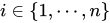
- Failed to parse (MathML with SVG or PNG fallback (recommended for modern browsers and accessibility tools): Invalid response ("Math extension cannot connect to Restbase.") from server "https://wikimedia.org/api/rest_v1/":): {\displaystyle \begin{align} R(\alpha_i) &= Q_1(\alpha_i)E_2(\alpha_i) - Q_2(\alpha_i)E_1(\alpha_i) \\ &= y_iE_1(\alpha_i)E_2(\alpha_i) - y_iE_2(\alpha_i)E_1(\alpha_i) \\ &= 0 \end{align}}
Thus has Failed to parse (MathML with SVG or PNG fallback (recommended for modern browsers and accessibility tools): Invalid response ("Math extension cannot connect to Restbase.") from server "https://wikimedia.org/api/rest_v1/":): {\displaystyle n} roots, on the other hand


Therefore, Failed to parse (MathML with SVG or PNG fallback (recommended for modern browsers and accessibility tools): Invalid response ("Math extension cannot connect to Restbase.") from server "https://wikimedia.org/api/rest_v1/":): {\displaystyle R} is the zero polynomial which means that and Failed to parse (MathML with SVG or PNG fallback (recommended for modern browsers and accessibility tools): Invalid response ("Math extension cannot connect to Restbase.") from server "https://wikimedia.org/api/rest_v1/":): {\displaystyle Q_2E_1} are identical. Since are non-zero we can write: Failed to parse (MathML with SVG or PNG fallback (recommended for modern browsers and accessibility tools): Invalid response ("Math extension cannot connect to Restbase.") from server "https://wikimedia.org/api/rest_v1/":): {\displaystyle \tfrac{Q_1}{E_1} = \tfrac{Q_2}{E_2}} as per our initial claim.


Thus based on the above claims, we can safely state that the output of the Berlekamp Welch algorithm, when outputting the polynomial is correct.

We can now claim that the algorithm can be implemented such that it has a running time of Failed to parse (MathML with SVG or PNG fallback (recommended for modern browsers and accessibility tools): Invalid response ("Math extension cannot connect to Restbase.") from server "https://wikimedia.org/api/rest_v1/":): {\displaystyle O(n^3)} . This can be proved as follows: In Step 1 of the algorithm, the polynomials and Failed to parse (MathML with SVG or PNG fallback (recommended for modern browsers and accessibility tools): Invalid response ("Math extension cannot connect to Restbase.") from server "https://wikimedia.org/api/rest_v1/":): {\displaystyle E} have and Failed to parse (MathML with SVG or PNG fallback (recommended for modern browsers and accessibility tools): Invalid response ("Math extension cannot connect to Restbase.") from server "https://wikimedia.org/api/rest_v1/":): {\displaystyle e + 1} unknown values respectively and the constraints for all acts as a linear equation with these unknowns. We therefore get a system of linear equations in Failed to parse (MathML with SVG or PNG fallback (recommended for modern browsers and accessibility tools): Invalid response ("Math extension cannot connect to Restbase.") from server "https://wikimedia.org/api/rest_v1/":): {\displaystyle 2e + k + 1 < n + 2} unknowns. Using our first claim, this system of equations has a solution since This can be solved in Failed to parse (MathML with SVG or PNG fallback (recommended for modern browsers and accessibility tools): Invalid response ("Math extension cannot connect to Restbase.") from server "https://wikimedia.org/api/rest_v1/":): {\displaystyle O(n^3)} time, by say Gaussian elimination. Finally, we can note that Step 2 of the algorithm can also be implemented in time by "long division" method. Hence we can state that the Berlekamp Welch algorithm can be used to uniquely decode any Reed–Solomon code in Failed to parse (MathML with SVG or PNG fallback (recommended for modern browsers and accessibility tools): Invalid response ("Math extension cannot connect to Restbase.") from server "https://wikimedia.org/api/rest_v1/":): {\displaystyle O(n^3)} time for a maximum of errors.



![{\displaystyle [n,k]_{q}}](https://wikimedia.org/api/rest_v1/media/math/render/svg/51af91d3d420bcc76cab96040b5181a716812f0c)

Example
Consider a simple example where a redundant set of points are used to represent the line , and one of the points is incorrect. The points that the algorithm gets as an input are Failed to parse (MathML with SVG or PNG fallback (recommended for modern browsers and accessibility tools): Invalid response ("Math extension cannot connect to Restbase.") from server "https://wikimedia.org/api/rest_v1/":): {\displaystyle (1,4), (2,3), (3,4), (4,1)} , where is the defective point. The algorithm must solve the following system of equations:


- Failed to parse (MathML with SVG or PNG fallback (recommended for modern browsers and accessibility tools): Invalid response ("Math extension cannot connect to Restbase.") from server "https://wikimedia.org/api/rest_v1/":): {\displaystyle \begin{align} Q(1) & = 4*E(1) \\ Q(2) & = 3*E(2) \\ Q(3) & = 4*E(3) \\ Q(4) & = 1*E(4) \end{align}}
Given a solution pair to this system of equations, it is evident that at any of the points one of the following must be true:


Since Failed to parse (MathML with SVG or PNG fallback (recommended for modern browsers and accessibility tools): Invalid response ("Math extension cannot connect to Restbase.") from server "https://wikimedia.org/api/rest_v1/":): {\displaystyle E} is defined as only having a degree of one, the former can only be true in one point. Therefore, at the three other points.
Letting Failed to parse (MathML with SVG or PNG fallback (recommended for modern browsers and accessibility tools): Invalid response ("Math extension cannot connect to Restbase.") from server "https://wikimedia.org/api/rest_v1/":): {\displaystyle E(x) = x + e_0} and we can rewrite the system:


This system can be solved through Gaussian elimination, and gives the values:
- Failed to parse (MathML with SVG or PNG fallback (recommended for modern browsers and accessibility tools): Invalid response ("Math extension cannot connect to Restbase.") from server "https://wikimedia.org/api/rest_v1/":): {\displaystyle q_0 = -15, q_1 = 8, q_2 = -1, e_0 = -3}
Thus:

Failed to parse (MathML with SVG or PNG fallback (recommended for modern browsers and accessibility tools): Invalid response ("Math extension cannot connect to Restbase.") from server "https://wikimedia.org/api/rest_v1/":): {\displaystyle 5-x} fits three of the four points given, so it is the most likely to be the original polynomial.
