(diff) ← Older revision | Latest revision (diff) | Newer revision → (diff)
In coding theory, the weight enumerator polynomial of a binary linear code specifies the number of words of each possible Hamming weight.
Let  be a binary linear code length
  . The weight distribution is the sequence of numbers

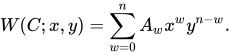
giving the number of codewords c in C having weight t as t ranges from 0 to n. The weight enumerator is the bivariate polynomial
Basic properties

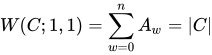


MacWilliams identity
Denote the dual code of by

(where  denotes the vector dot product and which is taken over
  ).
).
The MacWilliams identity states that

The identity is named after Jessie MacWilliams.
Distance enumerator
The distance distribution or inner distribution of a code C of size M and length n is the sequence of numbers

where i ranges from 0 to n. The distance enumerator polynomial is
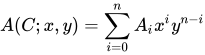
and when C is linear this is equal to the weight enumerator.
The outer distribution of C is the 2n-by-n+1 matrix B with rows indexed by elements of GF(2)n and columns indexed by integers 0...n, and entries

The sum of the rows of B is M times the inner distribution vector (A0,...,An).
A code C is regular if the rows of B corresponding to the codewords of C are all equal.
Source
http://wikipedia.org/
See Also on BitcoinWiki
