|
|
Degree of anonymity
In anonymity networks (e.g., Tor, Crowds, Mixmaster, I2P, etc.), it is important to be able to measure quantitatively the guarantee that is given to the system. The degree of anonymity is a device that was proposed at the 2002 Privacy Enhancing Technology (PET) conference. There were two papers that put forth the idea of using entropy as the basis for formally measuring anonymity: "Towards an Information Theoretic Metric for Anonymity", and "Towards Measuring Anonymity". The ideas presented are very similar with minor differences in the final definition of .
Contents
- 1 Background
- 2 Degree of Anonymity
- 3 Example Failed to parse (MathML with SVG or PNG fallback (recommended for modern browsers and accessibility tools): Invalid response ("Math extension cannot connect to Restbase.") from server "https://wikimedia.org/api/rest_v1/":): {\displaystyle d}
- 4 See also
- 5 Source
Background
Anonymity networks have been developed and many have introduced methods of proving the anonymity guarantees that are possible, originally with simple Chaum Mixes and Pool Mixes the size of the set of users was seen as the security that the system could provide to a user. This had a number of problems; intuitively if the network is international then it is unlikely that a message that contains only Urdu came from the United States, and vice versa. Information like this and via methods like the predecessor attack and intersection attack helps an attacker increase the probability that a user sent the message.
Example With Pool Mixes
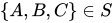
As an example consider the network shown above, in here Failed to parse (Conversion error. Server ("https://wikimedia.org/api/rest_") reported: "Cannot get mml. Server problem."): {\displaystyle A,B,C} and are users (senders), , and Failed to parse (Conversion error. Server ("https://wikimedia.org/api/rest_") reported: "Cannot get mml. Server problem."): {\displaystyle T} are servers (receivers), the boxes are mixes, and Failed to parse (MathML with SVG or PNG fallback (recommended for modern browsers and accessibility tools): Invalid response ("Math extension cannot connect to Restbase.") from server "https://wikimedia.org/api/rest_v1/":): {\displaystyle \{A, B\} \in T} , Failed to parse (MathML with SVG or PNG fallback (recommended for modern browsers and accessibility tools): Invalid response ("Math extension cannot connect to Restbase.") from server "https://wikimedia.org/api/rest_v1/":): {\displaystyle \{A, B, C\} \in S} and Failed to parse (MathML with SVG or PNG fallback (recommended for modern browsers and accessibility tools): Invalid response ("Math extension cannot connect to Restbase.") from server "https://wikimedia.org/api/rest_v1/":): {\displaystyle \{A, B, C, D\} \in Q, R} where Failed to parse (MathML with SVG or PNG fallback (recommended for modern browsers and accessibility tools): Invalid response ("Math extension cannot connect to Restbase.") from server "https://wikimedia.org/api/rest_v1/":): {\displaystyle \in} denotes the anonymity set. Now as there are pool mixes let the cap on the number of incoming messages to wait before sending be Failed to parse (MathML with SVG or PNG fallback (recommended for modern browsers and accessibility tools): Invalid response ("Math extension cannot connect to Restbase.") from server "https://wikimedia.org/api/rest_v1/":): {\displaystyle 2} ; as such if Failed to parse (MathML with SVG or PNG fallback (recommended for modern browsers and accessibility tools): Invalid response ("Math extension cannot connect to Restbase.") from server "https://wikimedia.org/api/rest_v1/":): {\displaystyle A, B} , or Failed to parse (MathML with SVG or PNG fallback (recommended for modern browsers and accessibility tools): Invalid response ("Math extension cannot connect to Restbase.") from server "https://wikimedia.org/api/rest_v1/":): {\displaystyle C} is communicating with and Failed to parse (MathML with SVG or PNG fallback (recommended for modern browsers and accessibility tools): Invalid response ("Math extension cannot connect to Restbase.") from server "https://wikimedia.org/api/rest_v1/":): {\displaystyle S} receives a message then Failed to parse (MathML with SVG or PNG fallback (recommended for modern browsers and accessibility tools): Invalid response ("Math extension cannot connect to Restbase.") from server "https://wikimedia.org/api/rest_v1/":): {\displaystyle S} knows that it must have come from ??Failed to parse (MathML with SVG or PNG fallback (recommended for modern browsers and accessibility tools): Invalid response ("Math extension cannot connect to Restbase.") from server "https://wikimedia.org/api/rest_v1/":): {\displaystyle E} ?? (as the links between the mixes can only have Failed to parse (MathML with SVG or PNG fallback (recommended for modern browsers and accessibility tools): Invalid response ("Math extension cannot connect to Restbase.") from server "https://wikimedia.org/api/rest_v1/":): {\displaystyle 1} message at a time). This is in no way reflected in Failed to parse (MathML with SVG or PNG fallback (recommended for modern browsers and accessibility tools): Invalid response ("Math extension cannot connect to Restbase.") from server "https://wikimedia.org/api/rest_v1/":): {\displaystyle S} 's anonymity set, but should be taken into account in the analysis of the network.
Degree of Anonymity
The degree of anonymity takes into account the probability associated with each user, it begins by defining the entropy of the system (here is where the papers differ slightly but only with notation, we will use the notation from .):
Failed to parse (MathML with SVG or PNG fallback (recommended for modern browsers and accessibility tools): Invalid response ("Math extension cannot connect to Restbase.") from server "https://wikimedia.org/api/rest_v1/":): {\displaystyle H(X) := \sum_{i=1}^{N} \left[p_i \cdot \lg\left(\frac{1}{p_i}\right)\right]}
,
where Failed to parse (MathML with SVG or PNG fallback (recommended for modern browsers and accessibility tools): Invalid response ("Math extension cannot connect to Restbase.") from server "https://wikimedia.org/api/rest_v1/":): {\displaystyle H(X)}
is the entropy of the network, is the number of nodes in the network, and Failed to parse (MathML with SVG or PNG fallback (recommended for modern browsers and accessibility tools): Invalid response ("Math extension cannot connect to Restbase.") from server "https://wikimedia.org/api/rest_v1/":): {\displaystyle p_i}
is the probability associated with node Failed to parse (MathML with SVG or PNG fallback (recommended for modern browsers and accessibility tools): Invalid response ("Math extension cannot connect to Restbase.") from server "https://wikimedia.org/api/rest_v1/":): {\displaystyle i}
.
Now the maximal entropy of a network occurs when there is uniform probability associated with each node Failed to parse (MathML with SVG or PNG fallback (recommended for modern browsers and accessibility tools): Invalid response ("Math extension cannot connect to Restbase.") from server "https://wikimedia.org/api/rest_v1/":): {\displaystyle \left(\frac{1}{N}\right)}
and this yields Failed to parse (MathML with SVG or PNG fallback (recommended for modern browsers and accessibility tools): Invalid response ("Math extension cannot connect to Restbase.") from server "https://wikimedia.org/api/rest_v1/":): {\displaystyle H_M := H(X) \gets \lg(N)}
.
The degree of anonymity (now the papers differ slightly in the definition here, defines a bounded degree where it is compared to Failed to parse (MathML with SVG or PNG fallback (recommended for modern browsers and accessibility tools): Invalid response ("Math extension cannot connect to Restbase.") from server "https://wikimedia.org/api/rest_v1/":): {\displaystyle H_M}
and gives an unbounded definition—using the entropy directly, we will consider only the bounded case here) is defined as
Failed to parse (MathML with SVG or PNG fallback (recommended for modern browsers and accessibility tools): Invalid response ("Math extension cannot connect to Restbase.") from server "https://wikimedia.org/api/rest_v1/":): {\displaystyle d := 1 - \frac{H_M - H(X)}{H_M} = \frac{H(X)}{H_M}}
.
Using this anonymity systems can be compared and evaluated using a quantitatively analysis.
Definition of Attacker
These papers also served to give concise definitions of an attacker:
- Internal/External
- an internal attacker controls nodes in the network, whereas an external can only compromise communication channels between nodes.
- Passive/Active
- an active attacker can add, remove, and modify any messages, whereas a passive attacker can only listen to the messages.
- Local/Global
- a local attacker has access to only part of the network, whereas a global can access the entire network.
Example Failed to parse (MathML with SVG or PNG fallback (recommended for modern browsers and accessibility tools): Invalid response ("Math extension cannot connect to Restbase.") from server "https://wikimedia.org/api/rest_v1/":): {\displaystyle d}
In the papers there are a number of example calculations of ; we will walk through some of them here.
Crowds
In Crowds there is a global probability of forwarding (Failed to parse (MathML with SVG or PNG fallback (recommended for modern browsers and accessibility tools): Invalid response ("Math extension cannot connect to Restbase.") from server "https://wikimedia.org/api/rest_v1/":): {\displaystyle p_f} ), which is the probability a node will forward the message internally instead of routing it to the final destination. Let there be Failed to parse (MathML with SVG or PNG fallback (recommended for modern browsers and accessibility tools): Invalid response ("Math extension cannot connect to Restbase.") from server "https://wikimedia.org/api/rest_v1/":): {\displaystyle C} corrupt nodes and Failed to parse (MathML with SVG or PNG fallback (recommended for modern browsers and accessibility tools): Invalid response ("Math extension cannot connect to Restbase.") from server "https://wikimedia.org/api/rest_v1/":): {\displaystyle N} total nodes. In Crowds the attacker is internal, passive, and local. Trivially Failed to parse (MathML with SVG or PNG fallback (recommended for modern browsers and accessibility tools): Invalid response ("Math extension cannot connect to Restbase.") from server "https://wikimedia.org/api/rest_v1/":): {\displaystyle H_M \gets \lg (N - C)} , and overall the entropy is Failed to parse (MathML with SVG or PNG fallback (recommended for modern browsers and accessibility tools): Invalid response ("Math extension cannot connect to Restbase.") from server "https://wikimedia.org/api/rest_v1/":): {\displaystyle H(x) \gets \frac{N - p_f \cdot (N - C - 1) }{N} \cdot \lg\left[\frac{N}{N - p_f \cdot (N - C - 1)}\right] + p_f \cdot \frac{N - C - 1}{N} \cdot \lg\left[N/p_f\right]} , Failed to parse (MathML with SVG or PNG fallback (recommended for modern browsers and accessibility tools): Invalid response ("Math extension cannot connect to Restbase.") from server "https://wikimedia.org/api/rest_v1/":): {\displaystyle d} is this value divided by Failed to parse (MathML with SVG or PNG fallback (recommended for modern browsers and accessibility tools): Invalid response ("Math extension cannot connect to Restbase.") from server "https://wikimedia.org/api/rest_v1/":): {\displaystyle H_M} .
Onion routing
In onion routing let's assume the attacker can exclude a subset of the nodes from the network, then the entropy would easily be Failed to parse (Conversion error. Server ("https://wikimedia.org/api/rest_") reported: "Cannot get mml. Server problem."): {\displaystyle H(X)\gets \lg(S)} , where Failed to parse (MathML with SVG or PNG fallback (recommended for modern browsers and accessibility tools): Invalid response ("Math extension cannot connect to Restbase.") from server "https://wikimedia.org/api/rest_v1/":): {\displaystyle S} is the size of the subset of non-excluded nodes. Under an attack model where a node can both globally listen to message passing and is a node on the path this decreases to Failed to parse (MathML with SVG or PNG fallback (recommended for modern browsers and accessibility tools): Invalid response ("Math extension cannot connect to Restbase.") from server "https://wikimedia.org/api/rest_v1/":): {\displaystyle H(X) \gets \lg(L)} , where Failed to parse (MathML with SVG or PNG fallback (recommended for modern browsers and accessibility tools): Invalid response ("Math extension cannot connect to Restbase.") from server "https://wikimedia.org/api/rest_v1/":): {\displaystyle L} is the length of the onion route (this could be larger or smaller than Failed to parse (MathML with SVG or PNG fallback (recommended for modern browsers and accessibility tools): Invalid response ("Math extension cannot connect to Restbase.") from server "https://wikimedia.org/api/rest_v1/":): {\displaystyle S} ), as there is no attempt in onion routing to remove the correlation between the incoming and outgoing messages.

Applications of this metric
In 2004, Diaz, Sassaman, and DeWitte presented an analysis of two anonymous remailers using the Serjantov and Danezis metric, showing one of them to provide zero anonymity under certain realistic conditions.