|
|
Expander code
In coding theory, expander codes form a class of error-correcting codes that are constructed from bipartite expander graphs. Along with Justesen codes, expander codes are of particular interest since they have a constant positive rate, a constant positive relative distance, and a constant alphabet size. In fact, the alphabet contains only two elements, so expander codes belong to the class of binary codes. Furthermore, expander codes can be both encoded and decoded in time proportional to the block length of the code. Expander codes are the only known asymptotically good codes which can be both encoded and decoded from a constant fraction of errors in polynomial time.
Contents
Expander codes
In coding theory, an expander code is a linear block code whose parity check matrix is the adjacency matrix of a bipartite expander graph. These codes have good relative distance , where and are properties of the expander graph as defined later), rate , and decodability (algorithms of running time exist).
![{\displaystyle [n,n-m]_{2}\,}](https://wikimedia.org/api/rest_v1/media/math/render/svg/3bcbaa3b1de5c4084b750ad7b5b8bf2aaac1e690)


Definition
Consider a bipartite graph , where and are the vertex sets and is the set of edges connecting vertices in to vertices of . Suppose every vertex in has degree (the graph is -regular), , and , . Then is a expander graph if every small enough subset , has the property that has at least distinct neighbors in . Note that this holds trivially for . When and for a constant , we say that is a lossless expander.





Since is a bipartite graph, we may consider its adjacency matrix. Then the linear code generated by viewing the transpose of this matrix as a parity check matrix is an expander code.


It has been shown that nontrivial lossless expander graphs exist. Moreover, we can explicitly construct them.
Rate
The rate of is its dimension divided by its block length. In this case, the parity check matrix has size , and hence has dimension at least .


Distance
Suppose . Then the distance of a expander code is at least .



Proof
Note that we can consider every codeword in as a subset of vertices , by saying that vertex if and only if the th index of the codeword is a 1. Then is a codeword iff every vertex is adjacent to an even number of vertices in . (In order to be a codeword, , where is the parity check matrix. Then, each vertex in corresponds to each column of . Matrix multiplication over then gives the desired result.) So, if a vertex is adjacent to a single vertex in , we know immediately that is not a codeword. Let denote the neighbors in of , and denote those neighbors of which are unique, i.e., adjacent to a single vertex of .





Lemma 1
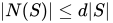
For every of size , .

Proof
Trivially, , since implies . follows since the degree of every vertex in is . By the expansion property of the graph, there must be a set of edges which go to distinct vertices. The remaining edges make at most neighbors not unique, so .






Corollary
Every sufficiently small has a unique neighbor. This follows since .
Lemma 2
Every subset with has a unique neighbor.


Proof
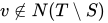
Lemma 1 proves the case , so suppose . Let such that . By Lemma 1, we know that . Then a vertex is in iff , and we know that , so by the first part of Lemma 1, we know . Since , , and hence is not empty.









Corollary
Note that if a has at least 1 unique neighbor, i.e. , then the corresponding word corresponding to cannot be a codeword, as it will not multiply to the all zeros vector by the parity check matrix. By the previous argument, . Since is linear, we conclude that has distance at least .



Encoding
The encoding time for an expander code is upper bounded by that of a general linear code - by matrix multiplication. A result due to Spielman shows that encoding is possible in time.

Decoding
Decoding of expander codes is possible in time when using the following algorithm.

Let be the vertex of that corresponds to the th index in the codewords of . Let be a received word, and . Let be is evenFailed to parse (MathML with SVG or PNG fallback (recommended for modern browsers and accessibility tools): Invalid response ("Math extension cannot connect to Restbase.") from server "https://wikimedia.org/api/rest_v1/":): {\displaystyle \}|\,} , and be Failed to parse (MathML with SVG or PNG fallback (recommended for modern browsers and accessibility tools): Invalid response ("Math extension cannot connect to Restbase.") from server "https://wikimedia.org/api/rest_v1/":): {\displaystyle |\{v \in R | N(v) \cap V(y) \,} is odd. Then consider the greedy algorithm:







Input: received codeword Failed to parse (MathML with SVG or PNG fallback (recommended for modern browsers and accessibility tools): Invalid response ("Math extension cannot connect to Restbase.") from server "https://wikimedia.org/api/rest_v1/":): {\displaystyle y\,}
.
initialize y' to y
while there is a v in R adjacent to an odd number of vertices in V(y')
if there is an i such that o(i) > e(i)
flip entry i in y'
else
fail
Output: fail, or modified codeword .

Proof
We show first the correctness of the algorithm, and then examine its running time.
Correctness
We must show that the algorithm terminates with the correct codeword when the received codeword is within half the code's distance of the original codeword. Let the set of corrupt variables be Failed to parse (MathML with SVG or PNG fallback (recommended for modern browsers and accessibility tools): Invalid response ("Math extension cannot connect to Restbase.") from server "https://wikimedia.org/api/rest_v1/":): {\displaystyle S\,} , , and the set of unsatisfied (adjacent to an odd number of vertices) vertices in be Failed to parse (MathML with SVG or PNG fallback (recommended for modern browsers and accessibility tools): Invalid response ("Math extension cannot connect to Restbase.") from server "https://wikimedia.org/api/rest_v1/":): {\displaystyle c\,} . The following lemma will prove useful.

Lemma 3
If , then there is a with Failed to parse (MathML with SVG or PNG fallback (recommended for modern browsers and accessibility tools): Invalid response ("Math extension cannot connect to Restbase.") from server "https://wikimedia.org/api/rest_v1/":): {\displaystyle o(i) > e(i)\,} .

Proof
By Lemma 1, we know that . So an average vertex has at least Failed to parse (MathML with SVG or PNG fallback (recommended for modern browsers and accessibility tools): Invalid response ("Math extension cannot connect to Restbase.") from server "https://wikimedia.org/api/rest_v1/":): {\displaystyle d(1-2\varepsilon) > d/2\,} unique neighbors (recall unique neighbors are unsatisfied and hence contribute to ), since , and thus there is a vertex with .


So, if we have not yet reached a codeword, then there will always be some vertex to flip. Next, we show that the number of errors can never increase beyond Failed to parse (MathML with SVG or PNG fallback (recommended for modern browsers and accessibility tools): Invalid response ("Math extension cannot connect to Restbase.") from server "https://wikimedia.org/api/rest_v1/":): {\displaystyle \gamma n\,} .
Lemma 4
If we start with , then we never reach at any point in the algorithm.


Proof
When we flip a vertex Failed to parse (MathML with SVG or PNG fallback (recommended for modern browsers and accessibility tools): Invalid response ("Math extension cannot connect to Restbase.") from server "https://wikimedia.org/api/rest_v1/":): {\displaystyle v_i\,} , and Failed to parse (MathML with SVG or PNG fallback (recommended for modern browsers and accessibility tools): Invalid response ("Math extension cannot connect to Restbase.") from server "https://wikimedia.org/api/rest_v1/":): {\displaystyle e(i)\,} are interchanged, and since we had , this means the number of unsatisfied vertices on the right decreases by at least one after each flip. Since , the initial number of unsatisfied vertices is at most , by the graph's -regularity. If we reached a string with errors, then by Lemma 1, there would be at least unique neighbors, which means there would be at least Failed to parse (MathML with SVG or PNG fallback (recommended for modern browsers and accessibility tools): Invalid response ("Math extension cannot connect to Restbase.") from server "https://wikimedia.org/api/rest_v1/":): {\displaystyle d\gamma(1-2\varepsilon)n\,} unsatisfied vertices, a contradiction.


Lemmas 3 and 4 show us that if we start with (half the distance of Failed to parse (MathML with SVG or PNG fallback (recommended for modern browsers and accessibility tools): Invalid response ("Math extension cannot connect to Restbase.") from server "https://wikimedia.org/api/rest_v1/":): {\displaystyle C\,} ), then we will always find a vertex to flip. Each flip reduces the number of unsatisfied vertices in Failed to parse (MathML with SVG or PNG fallback (recommended for modern browsers and accessibility tools): Invalid response ("Math extension cannot connect to Restbase.") from server "https://wikimedia.org/api/rest_v1/":): {\displaystyle R\,} by at least 1, and hence the algorithm terminates in at most steps, and it terminates at some codeword, by Lemma 3. (Were it not at a codeword, there would be some vertex to flip). Lemma 4 shows us that we can never be farther than Failed to parse (MathML with SVG or PNG fallback (recommended for modern browsers and accessibility tools): Invalid response ("Math extension cannot connect to Restbase.") from server "https://wikimedia.org/api/rest_v1/":): {\displaystyle \gamma n\,} away from the correct codeword. Since the code has distance (since ), the codeword it terminates on must be the correct codeword, since the number of bit flips is less than half the distance (so we couldn't have traveled far enough to reach any other codeword).


Complexity
We now show that the algorithm can achieve linear time decoding. Let Failed to parse (MathML with SVG or PNG fallback (recommended for modern browsers and accessibility tools): Invalid response ("Math extension cannot connect to Restbase.") from server "https://wikimedia.org/api/rest_v1/":): {\displaystyle \tfrac{n}{m}\,} be constant, and be the maximum degree of any vertex in . Note that is also constant for known constructions.

- Pre-processing: It takes Failed to parse (MathML with SVG or PNG fallback (recommended for modern browsers and accessibility tools): Invalid response ("Math extension cannot connect to Restbase.") from server "https://wikimedia.org/api/rest_v1/":): {\displaystyle O(mr)\,} time to compute whether each vertex in has an odd or even number of neighbors.
- Pre-processing 2: We take time to compute a list of vertices Failed to parse (MathML with SVG or PNG fallback (recommended for modern browsers and accessibility tools): Invalid response ("Math extension cannot connect to Restbase.") from server "https://wikimedia.org/api/rest_v1/":): {\displaystyle v_i\,} in which have Failed to parse (MathML with SVG or PNG fallback (recommended for modern browsers and accessibility tools): Invalid response ("Math extension cannot connect to Restbase.") from server "https://wikimedia.org/api/rest_v1/":): {\displaystyle o(i) > e(i)\,} .
- Each Iteration: We simply remove the first list element. To update the list of odd / even vertices in , we need only update Failed to parse (MathML with SVG or PNG fallback (recommended for modern browsers and accessibility tools): Invalid response ("Math extension cannot connect to Restbase.") from server "https://wikimedia.org/api/rest_v1/":): {\displaystyle O(d)\,} entries, inserting / removing as necessary. We then update entries in the list of vertices in Failed to parse (MathML with SVG or PNG fallback (recommended for modern browsers and accessibility tools): Invalid response ("Math extension cannot connect to Restbase.") from server "https://wikimedia.org/api/rest_v1/":): {\displaystyle L\,} with more odd than even neighbors, inserting / removing as necessary. Thus each iteration takes time.
- As argued above, the total number of iterations is at most Failed to parse (MathML with SVG or PNG fallback (recommended for modern browsers and accessibility tools): Invalid response ("Math extension cannot connect to Restbase.") from server "https://wikimedia.org/api/rest_v1/":): {\displaystyle m\,} .


This gives a total runtime of time, where Failed to parse (MathML with SVG or PNG fallback (recommended for modern browsers and accessibility tools): Invalid response ("Math extension cannot connect to Restbase.") from server "https://wikimedia.org/api/rest_v1/":): {\displaystyle d\,} and are constants.

See also
- Expander graph
- Low-density parity-check code
- Linear time encoding and decoding of error-correcting codes
- ABNNR and AEL codes
Notes
This article is based on Dr. Venkatesan Guruswami's course notes.
